
17 February 2026
Report exposes Big Tech’s AI climate hoax: 74% of industry’s claims about AI’s climate benefits are unproven
First critical analysis of industry’s statements on AI and climate impact
Berlin, 17 February 2026 – The big tech industry’s claims about the climate benefits of artificial intelligence (AI) are a hoax, according to a new report released today. A staggering 74% of claims about AI’s climate benefits are unproven, serving the profits of tech and fossil fuel industries, while downplaying the major climate harms of generative AI.[1]
The research looks at 154 statements claiming AI will serve as a net climate benefit – including from companies like Google and Microsoft, and from institutions such as the International Energy Agency – and, for the first time, critically analysed the assertion that AI will be a net benefit to climate action, making up for the increased fossil fuel demand by AI-driven data centres.
According to the findings, only 26% of the claims cited published academic papers and 36% did not cite any evidence at all. Overall, these claims tend to rely on weak forms of evidence rather than robust, peer-reviewed academic papers.
The report was commissioned and published by a consortium of environmental organisations including Beyond Fossil Fuels, Climate Action Against Disinformation (CAAD), Friends of the Earth U.S., Green Screen Coalition, Green Web Foundation, and Stand.earth, and was authored by climate and energy analyst Ketan Joshi. It is released ahead of the AI Impact Summit 2026 (19-20 February, New Delhi, India).[2]
The study examines the types of AI underpinning these claims, and the strength of the evidence put forth alongside them. The analysis did not uncover a single example where consumer generative systems such as ChatGPT, Gemini, or Copilot were leading to a material, verifiable, and substantial level of emissions reductions. It finds that claims about “AI sustainability” blur the differences between generative AI – which carries major environmental costs, with the much lower energy and environmental footprint of “traditional” AI, used for instance for machine learning to forecast wind patterns. This deceptive bait-and-switch is a new form of greenwashing used by the tech industry.
Ketan Joshi, Independent climate and energy analyst, said: “It appears tech companies are using vagueness about what happens within energy-hogging data centres to greenwash a planet-wrecking expansion. This has bled through into organisations like the International Energy Agency. The promises of planet-saving tech remain hollow, while AI data centres breathe life into coal and gas every day. These claims of climate benefit are unjustified and overhyped, and could cover up irreversible damage being done to communities and society.”
Jill McArdle, International Corporate Campaigner, Beyond Fossil Fuels, said: “Big Tech’s AI hype is distracting users from the rapid and dangerous expansion of giant, energy and water-intensive data centres, while the tech industry’s huge energy demands are throwing the fossil fuel industry a lifeline. There is simply no evidence that AI will help the climate more than it will harm it. Rather than relying on credible and substantiated data, Big Tech companies are writing themselves a blank cheque to pollute on the empty promise of future salvation. We cannot bet the climate on these baseless claims.”
Michael Khoo, Policy co-chair, Climate Action Against Disinformation, Program Director, Friends of the Earth U.S., said: “Any climate benefits are far outweighed by how much energy generative AI is using. By lumping traditional and generative AI together, possible climate solutions are bundled with extreme pollution, and presented as a package deal. Governments must require basic transparency from the AI industry so communities and scientists can know how much energy is being exploited for this technology.”
In short, the evidence that AI will lead to large-scale climate benefits is weak, whilst the evidence of immediate and substantial climate and environmental harm is strong.
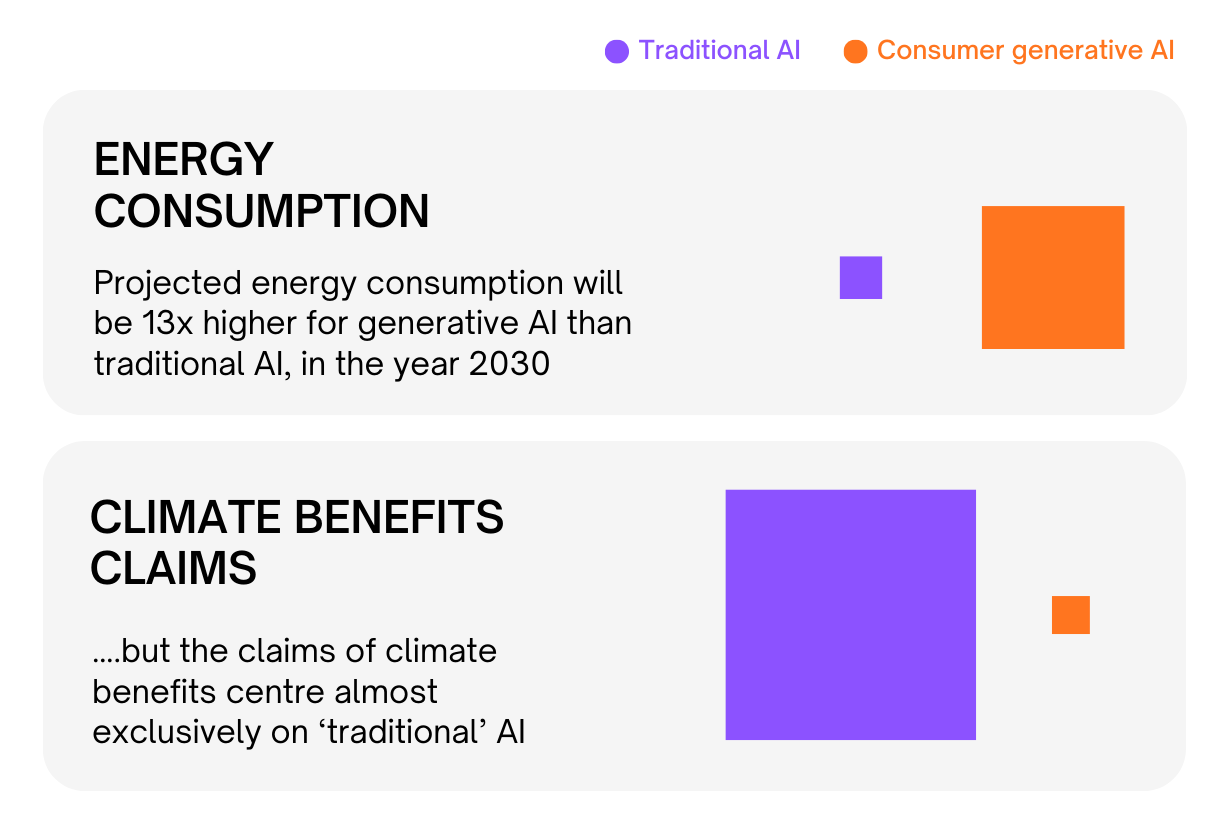
GRAPHIC: The majority of climate benefits are linked to traditional AI, while most harm stems from generative AI. The chart on the right compares claim numbers by type, the chart on the left compares projected 2030 electricity use. From the report’s executive summary.
Exaggerating AI’s climate potential distracts from the real costs of massive, energy- and water-hungry data centres imposed on communities worldwide.
Nathan Taft, Senior Campaigner Stand.earth, said: “The sheer scale of these AI data center buildouts could have global implications for the climate, and it also comes with serious impacts for local communities. The least these corporations can do is ensure that demand isn’t met with fossil fuels that pollute local communities. Hyperscalers can’t hand-wave away community concerns with sleight-of-hand promises of future clean energy, or greenwash its ongoing love affair with fossil fuels — these new data centers must be backed by new, locally sourced, 24/7 renewable energy before they go online, or not go online at all.”
The accelerated growth of AI is increasing pressure on the climate, and Big Tech must take responsibility for mitigating its environmental impacts. Companies must disclose their energy consumption and emissions, and be transparent about the environmental and social justice impacts of their technologies, and whether data centres are really serving the critical needs of society.
END
____________________________
CONTACTS
Jill McArdle, International Corporate Campaigner, Beyond Fossil Fuels, jill.mcardle@bff.earth, mobile +32 456 723 993 (English)
Pierre Terras, Corporate Programme Lead, Beyond Fossil Fuels, pierre.terras@bff.earth , mobile +33 646 90 21 04 (French, Spanish, English)
Shane Reese, Corporate Campaigns Media Director, Stand.earth, shane.reese@stand.earth , mobile +1 919 339 3785 (English)
NOTES
[1] METHODOLOGY
The analysis searched for prominent claims of a net benefit of the deployment of AI towards the project of climate action, using searches. Major reports, such as the International Energy Agency’s “Energy and AI” report, along with sustainability reports from Microsoft and Google, and several published papers were included in the analysis. Each claim was coded for the type of AI referenced and the type of evidence presented to buttress the claim. These were collated and presented according to the coding results. Generative AI was not knowingly used in any part of the production of this report.
[2] The AI Impact Summit is an international event on artificial intelligence (AI) that will take place in Delhi from 19 to 20 February 2026. It follows the AI Action Summit held in Paris in February 2025 and shows a shift away from government concerns about AI safety. According to the professional services firm Crowell, the summit moves the focus from “Safety” and “Action” to “Impact”.
About Beyond Fossil Fuels
Beyond Fossil Fuels is a civil society network committed to ensuring a just and rapid transition to a fossil-free, renewables-based future. Building upon the Europe Beyond Coal campaign, its goal is for Europe to be coal-free by 2030 and phase out fossil gas from the power sector by 2035. A clean and flexible energy system will deliver lasting benefits for people, the climate and the broader economy. Beyond Fossil Fuels is a non-profit organisation with an office in Berlin, with staff spread across Europe. www.beyondfossilfuels.org
About Stand.earth
Stand.earth is a global advocacy organization delivering large-scale change for our planet and its people by interrupting the systems that create environmental and climate crises. Its mission is to challenge corporations and governments to treat people and the environment with respect. Stand’s worldwide community of more than one million members advocates for a climate-safe, equitable future, where environmental and climate justice policies uphold the dignity of people everywhere – at the scale our world requires.
About Climate Action Against Disinformation
Climate Action Against Disinformation is a global coalition of over 120 leading climate and anti-disinformation organisations across the globe demanding robust, coordinated and proactive strategies to deal with the scale of the threat of climate misinformation and disinformation.
About Friends of the Earth U.S.
Friends of the Earth U.S. works to reduce the spread of disinformation that potentially affects all of our campaigns. As technology and media companies consolidate their power, our fundamental ability to campaign on any issue is threatened, as corporate polluters gain more control over the basic communications systems that are needed for social change and democracy itself.
https://foe.org/projects/disinformation/
About Green Screen Coalition
The Green Screen Climate Justice and Digital Rights Coalition is a group of funders and practitioners looking to build bridges across the digital rights and climate justice movements. The aim of the coalition is to be a catalyst in making visible the climate implications of technology by supporting emerging on-the-ground work, building networks, and embedding the issue as an area within philanthropy.
About Green Web Foundation
Green Web Foundation is a non-profit organisation working towards a fossil-free internet by 2030 by reducing absolute emissions and phasing out fossil fuels in data centers – fast, fairly and forever. The foundation maintains the world’s largest open dataset of websites that run on green energy and builds open source tools for measuring and mitigating emissions from digital services.